Bangkok on $25, $100 or $400 a day
Bangkok is one of the world's great food cities — from ฿50 pad thai on a plastic stool to Asia's number-one restaurant. Layer in ornate temples, a chaotic expressway system that somehow works, rivers and canals, and a nightlife that runs until dawn. The city rewards those who get lost in it.
Share
Plan by budget
One city, three ways to travel it.
How much does Bangkok cost per day? Budget travellers get by on about $25 a day, mid-range trips run around $100, and luxury starts near $400 — accommodation, food, transport and activities included. That makes Bangkok the 31st cheapest of 110 cities for a mid-range trip (see all 110 ranked).
Daily budget · Budget
Bangkok is one of Asia's best budget destinations. Street food is extraordinary at 50–150 baht (£1–4), guesthouses are clean and social, and the temple circuit is one of the world's great free experiences. The BTS Skytrain makes transport cheap and easy.
Where your money goes
How to Get There
What to Do
The riverside night bazaar on the old East Asiatic docks — 1,500 stalls, a giant ferris wheel, and the Calypso cabaret, all reached by free boat.
Read guide → Map ↗ Get tickets on Tiqets →Fight night at the world's oldest muay thai stadium — live gamblers' chorus, wai kru rituals, and the sport at its sanctified best since 1945.
Read guide → Map ↗ Get tickets on Tiqets →All of Thailand in 96 hectares — 120 monuments, rebuilt or rescued, on a park shaped like the country. Rent a bike and ride the kingdom in a day.
Read guide → Map ↗ Get tickets on Tiqets →Where to Stay
Near Democracy Monument, clean pods, rooftop bar
Map ↗ Check prices on Klook →Hostel accommodation with dorm beds and, usually, a few private rooms.
Map ↗ Check prices on Klook →Hostel accommodation with dorm beds and, usually, a few private rooms.
Check prices on Klook →Where to Eat
Bangkok's most famous pad thai — queue outside, under 60 baht, life-changing
Map ↗Weekend market food — mango sticky rice, grilled pork, freshly made satay
Map ↗The stalls around Jay Fai on Mahachai — same quality, no queue, no Michelin
Map ↗1 Michelin star for a street stall — drunken noodles and crab omelette, book ahead
Map ↗Sample 3-Day Itinerary
Temples & the River
Wat Phra Kaew + Grand Palace (฿500 — the only expensive must-do in Bangkok, non-negotiable). Dress code: shoulders and knees covered. Arrive at 8:30am when it opens. Walk to Wat Pho (฿200) for the giant reclining Buddha and a traditional Thai massage (฿260/hour — the cheapest and most authentic in the city).
Chao Phraya Express Boat to Wat Arun (฿100 return). The wat is stunning from across the river and from inside. Walk back along the riverside promenade. Stop at Pak Khlong Talat (flower market, free) on the way.
Dinner in Banglamphu: khao man gai (poached chicken rice) at a street stall for ฿60. Chang beer from a 7-Eleven for ฿50. Walk Khao San Road once for the experience (you don't have to stay).
Chinatown & Markets
Chatuchak Weekend Market (Saturday/Sunday only — 15,000 stalls, the largest market in the world, free entry). Vintage clothes, plants, street food, ceramics, and things you didn't know you needed. Arrive at 10am before it gets unbearably hot.
If not a weekend: Jim Thompson House (~฿200) — the teak mansion and Thai silk business of the American who disappeared in Malaysia in 1967. Then MBK Center for cheap electronics or Siam Square for street food.
Chinatown at night: walk Yaowarat Road from 7pm. Grilled prawns at a seafood restaurant (฿150–250/dish). Kuay teow reua (boat noodles, ฿30 per bowl) from a street cart. A fresh coconut for ฿40.
Floating Markets & Massage
Long-tail boat from Banglamphu pier to the Khlong Bang Luang floating market (฿50 each way by canal boat). Less touristy than Damnoen Saduak, genuinely atmospheric, free to wander. Artists and galleries have colonized the old riverside houses.
Return to the city. Lumpini Park (free) for an afternoon rest and watching monitor lizards in the lake. Traditional Thai massage in the Silom area (฿250–350/hour at a proper parlor, not a "massage" parlor).
Final dinner on the Chao Phraya river: Yok Yor Marina restaurant for seafood with a view (฿400–600 for a full meal). Or back to Yaowarat for mango sticky rice (฿80) and a final Chang.
Get a Rabbit Card for the BTS Skytrain — far better than taxis in traffic. Jay Fai's Michelin-starred crab omelette is accessible even on a budget (book months ahead though). Avoid the tourist pad thai on Khao San Road — go to Thip Samai near the Golden Mount instead.
Daily budget · Mid-range
Mid-range Bangkok is extraordinary value — boutique hotels, Michelin-starred restaurants at lunch prices, and private longtail boat hire. The city's hotel stock at $100–180/night is the best in Asia for the money. You'll feel like you're living in luxury.
Where your money goes
How to Get There
What to Do
The riverside night bazaar on the old East Asiatic docks — 1,500 stalls, a giant ferris wheel, and the Calypso cabaret, all reached by free boat.
Read guide → Map ↗ Get tickets on Tiqets →Fight night at the world's oldest muay thai stadium — live gamblers' chorus, wai kru rituals, and the sport at its sanctified best since 1945.
Read guide → Map ↗ Get tickets on Tiqets →All of Thailand in 96 hectares — 120 monuments, rebuilt or rescued, on a park shaped like the country. Rent a bike and ride the kingdom in a day.
Read guide → Map ↗ Get tickets on Tiqets →Where to Stay
Chao Phraya riverside, large pool, hotel boat to BTS station
Map ↗ Check prices on Klook →Boutique hotel facing Wat Arun across the river, extraordinary views
Map ↗ Check prices on Klook →Upper-tier international hotel: larger rooms, a pool or spa at most properties, central location.
Map ↗ Check prices on Klook →Where to Eat
Refined central Thai cooking in Sukhumvit, excellent mango curry
Map ↗David Thompson's Royal Thai cuisine, considered the world's finest traditional Thai
Map ↗Twin German chefs doing contemporary German-Thai fusion — surprisingly brilliant
Map ↗Sample 3-Day Itinerary
Royal Bangkok
Grand Palace and Wat Phra Kaew (฿500, worth every baht). Then Wat Pho (฿200) for the reclining Buddha and a proper 60-minute traditional massage (฿420). Cross the river to Wat Arun by ferry (฿5).
Lunch at Supanniga Eating Room in the riverside area — refined Thai classics in a beautiful old house, ฿400–600. Jim Thompson House tour (฿200) in the afternoon. Walk the National Museum if time allows.
Rooftop at Arun Residence (opposite Wat Arun — the view of the illuminated temple from river level is the best in Bangkok). Dinner at the same property's restaurant (฿600–1,000). Grab back to hotel.
Art & Night Markets
MOCA Bangkok (Museum of Contemporary Art, ฿250) — excellent collection of Thai modern art. Then Chatuchak or the Or Tor Kor market (the premium food market next to Chatuchak — the best fruits, spices, and prepared foods in Thailand).
BTS to Thonglor: Bangkok's most stylish street. Lunch at a Thai restaurant in the area (฿350–500). Browse the boutiques and concept stores. Massage at one of the upscale spas (฿700–1,200 for 90 minutes).
Khao San Road for a beer at sunset (the chaos is entertaining when you're not sleeping there). Then Grab to the Asiatique riverfront night market — restaurants, shops, a Ferris wheel, river views. Dinner here at ฿500–700.
Ayutthaya Day Trip
Minivan from Victory Monument to Ayutthaya (฿80 each way, 90 minutes). The ancient capital of Siam: ruined temples with Buddha heads entwined in tree roots, giant prangs, and almost no crowds if you arrive before 10am. Rent a bicycle (฿60/day) to cover the park.
Lunch at a riverside Ayutthaya restaurant (฿250–400). Return via the train (฿20 — the slowest but most atmospheric option, 2 hours). The countryside view from the windows is unexpectedly beautiful.
Back in Bangkok: dinner in Silom or Sathorn — Eat Me restaurant for creative international food (฿600–900), or a classic Thai at Baan Khanitha.
Many Bangkok Michelin-star restaurants accept walk-ins at lunch. Hire a longtail boat for a half-day on the canals (Khlongs) — around 1,200 baht. The Chao Phraya Express Boat is the most scenic commute in Asia at 15 baht.
Daily budget · Luxury
Luxury Bangkok is world-class — the Mandarin Oriental is consistently rated one of the world's best hotels, the restaurant scene runs from Gaggan Anand to Le Normandie, and private experiences (dawn temple tours, custom tailoring, spa retreats) are extraordinary value vs. comparable Western cities.
Where your money goes
How to Get There
What to Do
The riverside night bazaar on the old East Asiatic docks — 1,500 stalls, a giant ferris wheel, and the Calypso cabaret, all reached by free boat.
Read guide → Map ↗ Get tickets on Tiqets →Fight night at the world's oldest muay thai stadium — live gamblers' chorus, wai kru rituals, and the sport at its sanctified best since 1945.
Read guide → Map ↗ Get tickets on Tiqets →All of Thailand in 96 hectares — 120 monuments, rebuilt or rescued, on a park shaped like the country. Rent a bike and ride the kingdom in a day.
Read guide → Map ↗ Get tickets on Tiqets →Where to Stay
Chao Phraya riverside, iconic tower, three-tier pool overlooking the river
Map ↗ Check prices on Klook →The hotel that defined Asian luxury — authors' wing, river terrace, perfection
Map ↗ Check prices on Klook →Riverside ultra-luxury, the most beautiful new hotel in Bangkok
Map ↗ Check prices on Klook →Where to Eat
India's greatest chef in Bangkok — progressive emoji tasting menu, Asia's best
Map ↗Stunning 65th floor views, modern European fine dining, perfect for proposals
Map ↗2 Michelin stars at Mandarin Oriental, classic French with Chao Phraya views
Map ↗Sample 3-Day Itinerary
Private Temples & Thai Cooking
Private long-tail boat tour of the Bangkok klongs (canals) at 7am — before the heat, before the groups. The canals behind Rattanakosin reveal wooden stilt houses, spirit house shrines, and a Bangkok that hasn't changed in 50 years. Private guide explains the temple architecture.
Lunch at Nahm (David Thompson's landmark Thai restaurant — genuine royal Thai cooking, ฿2,000–3,000). Afternoon private Thai cooking class at a riverside house: markets visit, lesson, sit-down lunch.
Lebua Sky Bar at sunset (Condom-Dome bar is the same building, cheaper). Dinner at Mezzaluna (2 Michelin stars, 65th floor, panoramic Bangkok) or Sorn (southern Thai cuisine, 2 Michelin stars). ฿5,000–8,000 with wine.
Chao Phraya & Heritage
Sunrise cruise on a private rice barge with breakfast — the Chao Phraya in morning light, with monks receiving alms at riverside temples, is one of Southeast Asia's great travel experiences. The Mandarin Oriental organizes these.
The Artist's House in Thonburi (by longtail) — a traditional Thai puppet theater in a 200-year-old canal house. Then the Museum of Siam (฿300) for the best English-language presentation of Thai history. Lunch at Supanniga Eating Room.
Dinner at Le Normandie (Mandarin Oriental Bangkok, 2 Michelin stars) or Elements (Okura Bangkok) — French cuisine in the city that does French cooking better than expected. Traditional massage at the Oriental Spa after dinner.
Thai Spa & Farewell
Full morning at the Mandarin Oriental or Peninsula Bangkok spa: Thai herbal compress massage, scrub, and facial — a 3-hour ritual. Late breakfast on the terrace overlooking the Chao Phraya.
Shopping at Emporium and EmQuartier luxury malls (connected by sky bridge). Or a chauffeured trip to the Chatuchak premium section for unique Thai antiques and silk. Lunch at one of the EmQuartier rooftop restaurants.
Farewell dinner at Bo.lan (sustainable Thai, beloved by chefs worldwide) or Paste (refined Royal Thai court cuisine, 1 Michelin star). The last Thai meal should be the most considered.
Book Gaggan Anand months ahead — the progressive Indian tasting menu is one of Asia's genuine dining events. Request a river-facing room at the Mandarin Oriental. The Thai cooking class at the Oriental Thai Cooking School is a must.
Sight guides
Bangkok Sight Guides
About Bangkok
When to go, and what it's like on the ground.
Best time to visit
November – February (cool and dry season)
Tropical monsoon climate with three seasons: cool and dry (Nov–Feb, 25–30°C — the best time to visit), hot and dry (Mar–May, up to 40°C — genuinely brutal), and wet season (Jun–Oct — heavy afternoon rains but not constant). Songkran (Thai New Year, April 13–15) is an enormous water festival and one of the world's great street parties — but also the worst time to try to get anything done.
- January: 28°C average high, 2 rain days, high season
- February: 29°C average high, 3 rain days, high season
- March: 31°C average high, 4 rain days, moderate crowds
- April: 33°C average high, 6 rain days, moderate crowds
- May: 31°C average high, 14 rain days, low crowds
- June: 30°C average high, 16 rain days, low crowds
- July: 29°C average high, 17 rain days, low crowds
- August: 29°C average high, 18 rain days, low crowds
- September: 29°C average high, 17 rain days, low crowds
- October: 29°C average high, 14 rain days, moderate crowds
- November: 28°C average high, 7 rain days, high season
- December: 27°C average high, 3 rain days, high season
Getting around
Getting around Bangkok
Bangkok has two elevated rail systems: the BTS Skytrain (central districts) and the MRT subway (cross-city). A single trip costs ฿16–59 on the BTS. The Chao Phraya Express Boat (฿15–40) serves the riverside temples and markets. Taxis are metered and cheap (฿35 flagfall) but notoriously traffic-prone — use Grab (Thailand's Uber) for fixed prices and AC. Tuk-tuks are fun once; always agree a price before getting in.
A travel eSIM gets you online the moment you land in Thailand — data plans start at $4 — no roaming bill, no queue for a local SIM, and nothing to swap in and out of your phone. Install it before you fly.
On foot
Walking routes in Bangkok.
The city's central park at dawn, the glass-floor skywalk, and the Hindu temple in the middle of the business district.
The Grand Palace and the reclining Buddha, the ferry across to Wat Arun, then the flower market and Chinatown.
Where to stay
Bangkok, neighbourhood by neighbourhood.
Banglamphu & Khao San Road
The original Bangkok backpacker hub built around Khao San Road — 400 meters of pad thai stands, €2 cocktail buckets, and gap-year travelers from everywhere. Chaotic and self-contained, but the surrounding Banglamphu streets are genuinely atmospheric: old wooden shophouses, neighborhood temples, and the Democracy Monument just north.
Best for budgetRattanakosin (Old City)
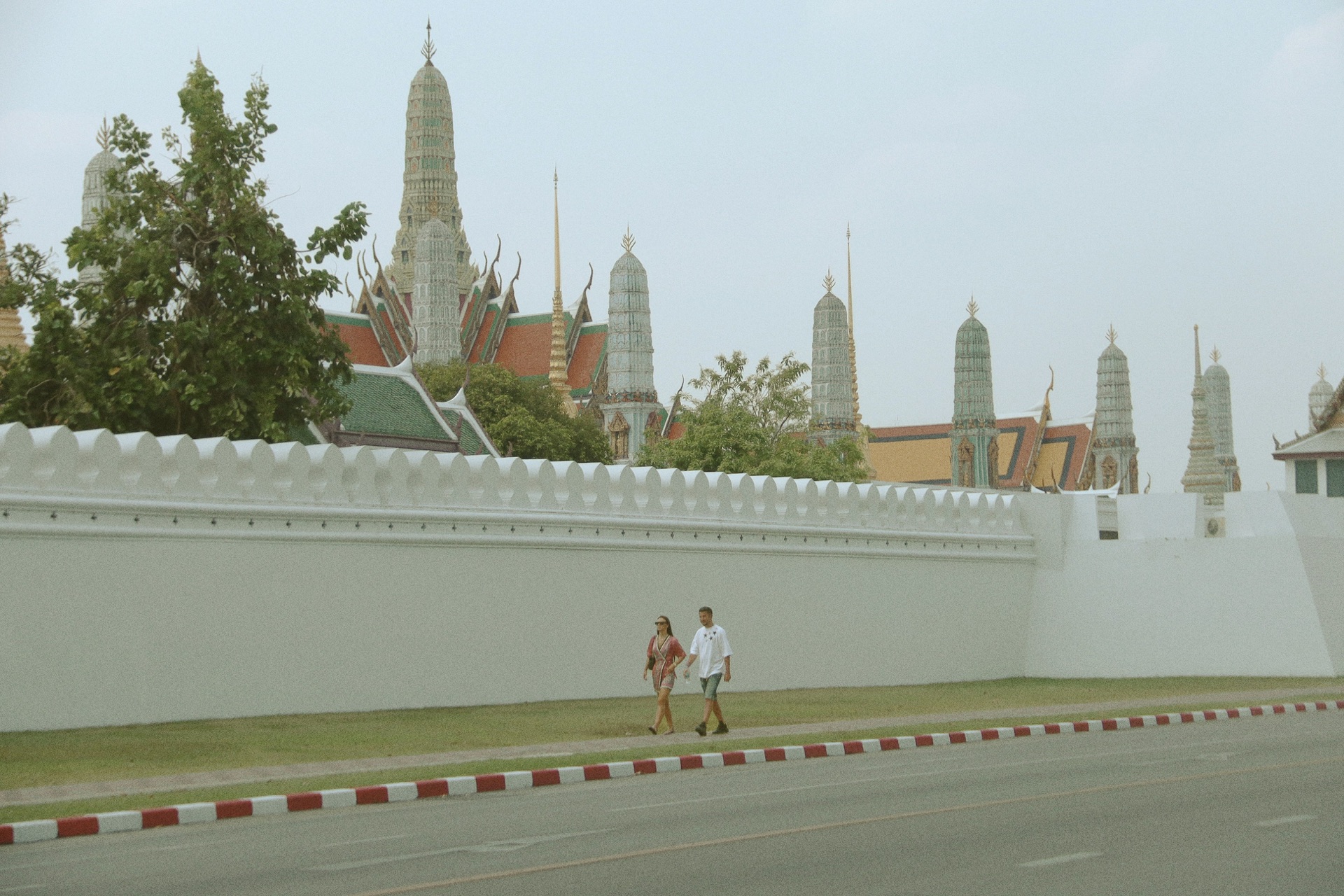
The artificial island at the heart of Bangkok: Wat Phra Kaew (Temple of the Emerald Buddha), the Grand Palace, Wat Pho (giant reclining Buddha, the birthplace of Thai massage), and Wat Arun across the river. All within walking distance of each other. Visit before 10am to avoid the worst heat and crowds. Dress code enforced — shoulders and knees covered.
Best for mid-rangeChinatown (Yaowarat)
Bangkok's Chinatown is one of the world's great street-eating destinations. Yaowarat Road at night: shark fin soup you shouldn't order, grilled seafood you should, pad see ew, mango sticky rice, and more gold shops per square meter than anywhere outside Dubai. The Talat Noi neighborhood behind it has beautiful street art and century-old shophouses.
Best for budgetSukhumvit
The long BTS corridor from Asok to Ekkamai is Bangkok's expat and tourist spine: Terminal 21 mall, the rooftop bar at Octave, street food on Sukhumvit Soi 38 (late night), and the highest concentration of international restaurants in Thailand. The Nana and Asok sections are nightlife heavy; Thonglor and Ekkamai are where Bangkok's fashionable young crowd goes.
Best for mid-rangeSilom & Sathorn
Bangkok's financial district by day, rooftop-bar destination by night. The Vertigo on the Banyan Tree hotel (63rd floor) and the Lebua Sky Bar (where The Hangover II was filmed) are both here. Patpong night market runs between the two main streets. Silom Soi 4 is the center of Bangkok's LGBTQ nightlife — enthusiastic and welcoming.
Best for luxuryAri & Victory Monument
North of the tourist trail, Ari is where Bangkok's young creative class lives: independent coffee shops, affordable Thai restaurants with no English menus, vintage clothes, and not a single tuk-tuk touting. A BTS stop from the chaos of Sukhumvit but a world apart. Victory Monument area has the city's best minivan terminals for day trips.
Best for budgetLocal etiquette
Dos & Don'ts
Do
- Dress respectfully at temples — shoulders and knees covered (sarongs available at entrances)
- Remove shoes before entering temples, traditional homes, and some shops
- Show respect for Buddha images and the Thai royal family at all times
- Greet with a wai — press palms together at chest height and bow slightly
- Carry Thai baht cash — markets, tuk-tuks, and small restaurants are cash-only
- Smile back — Thailand is the "Land of Smiles" and warmth is genuinely reciprocal
Don't
- Touch anyone's head — the head is considered the most sacred part of the body
- Point your feet at people or sacred objects — feet are considered spiritually low
- Criticise the Thai royal family — lèse-majesté laws carry serious criminal penalties
- Accept a gem deal from a friendly stranger near a temple — it is always a scam
- Pass items or eat with your left hand — it is considered unclean in Thai culture
- Haggle aggressively — bargaining is expected but must stay light and friendly
Useful phrases
Say it like a local.
Beyond the city
Day trips worth the journey.
Ayutthaya
Thailand's former capital: atmospheric ruins of temples and giant Buddha heads half-swallowed by banyan tree roots.
Kanchanaburi
The Bridge on the River Kwai, WWII Death Railway, Erawan's seven-tiered waterfalls, and tiger temple ruins.
Amphawa
Charming floating market town on a canal with wooden shop-houses, seafood boats, and fireflies at dusk.
Damnoen Saduak
Thailand's most famous floating market: narrow canals crowded with fruit, food, and vendor boats.
Erawan National Park
Seven pools of startling turquoise water beneath tiered limestone waterfalls — one of Thailand's most beautiful parks.
Where to eat
Must-try dishes.
Pad Thai
Stir-fried rice noodles with shrimp or chicken, bean sprouts, egg and tamarind sauce, topped with crushed peanuts.
Tom Yum Goong
Fiery lemongrass and lime prawn soup with galangal, kaffir lime leaves and Thai chilies. Bracing, sour and aromatic.
Som Tum
Green papaya salad pounded in a mortar with lime, fish sauce, chilies, tomatoes and dried shrimp — the intensity is adjustable.
Mango Sticky Rice
Sweet glutinous rice soaked in coconut cream served with perfectly ripe mango — best in April–May mango season.
Khao Pad
Thai fried rice cooked over screaming hot flame with egg, garlic, fish sauce and your choice of protein.
Boat Noodles
Small bowls of intensely flavoured noodle soup with blood-enriched broth — order multiple rounds at a riverside noodle shop.
Grilled Satay
Coconut-marinated pork or chicken skewers served with peanut sauce and cucumber ajad relish from street carts.
Travel insurance
Do I need travel insurance for Thailand?
Travel insurance is strongly recommended for any trip to Bangkok. Safety is rated Generally safe for tourists — petty theft and tuk-tuk scams exist but serious crime is rare — even in safe destinations, unexpected medical emergencies or trip cancellations can be costly. Make sure your policy covers emergency medical treatment, hospitalisation, trip cancellation, and emergency evacuation.
Visa note: 30 days visa-free on arrival for most Western passports. Extendable once at an immigration office. Check current rules — Thailand's visa policies change frequently.. Some countries require proof of travel insurance as part of the visa application.
Good to know
FAQ: Bangkok travel questions
Is Bangkok safe to visit?
Generally safe for tourists — petty theft and tuk-tuk scams exist but serious crime is rare
When is the best time to visit Bangkok?
November – February (cool and dry season) Tropical monsoon climate with three seasons: cool and dry (Nov–Feb, 25–30°C — the best time to visit), hot and dry (Mar–May, up to 40°C — genuinely brutal), and wet season (Jun–Oct — heavy afternoon rains but not constant). Songkran (Thai New Year, April 13–15) is an enormous water festival and one of the world's great street parties — but also the worst time to try to get anything done.
How much does a trip to Bangkok cost per day?
- Budget $25–$50 / day
- Mid-range $100–$180 / day
- Luxury $400–$800 / day
Do I need a visa to visit Thailand?
30 days visa-free on arrival for most Western passports. Extendable once at an immigration office. Check current rules — Thailand's visa policies change frequently.
How do I get around Bangkok?
Bangkok has two elevated rail systems: the BTS Skytrain (central districts) and the MRT subway (cross-city). A single trip costs ฿16–59 on the BTS. The Chao Phraya Express Boat (฿15–40) serves the riverside temples and markets. Taxis are metered and cheap (฿35 flagfall) but notoriously traffic-prone — use Grab (Thailand's Uber) for fixed prices and AC. Tuk-tuks are fun once; always agree a price before getting in. Bangkok has a metro system. Taxi base fare ~$1. Day pass ~$4.
Is tipping expected in Bangkok?
Not obligatory but appreciated. ฿20–50 for hotel staff, 10% at nice restaurants, round up taxi fares. Never tip with your foot on the bill — deeply offensive.
What currency is used in Thailand?
The local currency is THB (฿) — Thai baht. ATMs widely available; airport exchange rates are poor., and the official language is Thai (English in tourist areas, tourist staff, and malls).
Compare