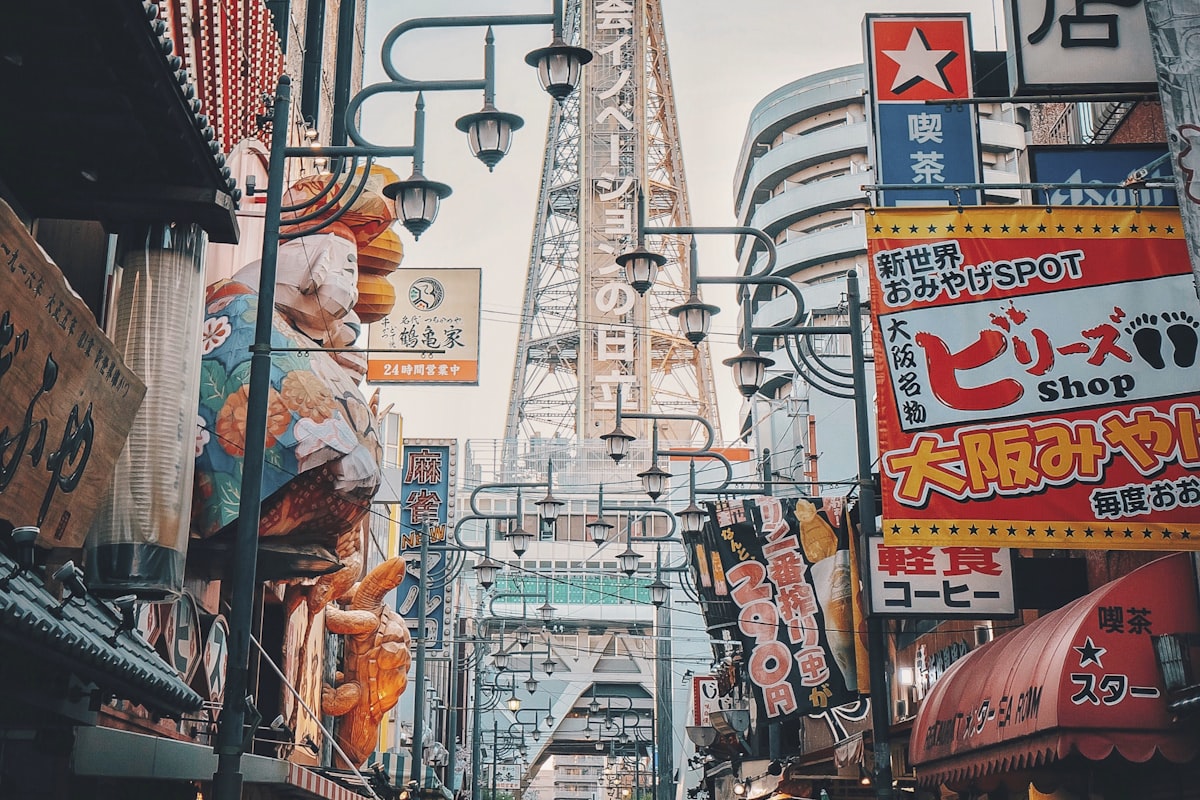
Osaka on $50, $110 or $350 a day
Osaka is Japan's culinary capital and most exuberant city — a place where the food is extraordinary, the people are famously warm, and the streets pulse with neon and street food from dusk until dawn. The locals' saying "kuidaore" (eat until you drop) is not an exaggeration.
Share
Plan by budget
One city, three ways to travel it.
How much does Osaka cost per day? Budget travellers get by on about $50 a day, mid-range trips run around $110, and luxury starts near $350 — accommodation, food, transport and activities included. That makes Osaka the 47th cheapest of 110 cities for a mid-range trip (see all 110 ranked).
Daily budget · Budget
Osaka is among Asia's best cities for budget travel. The food alone justifies the trip — takoyaki for ¥300, a bowl of ramen for ¥800, and conveyor-belt sushi where you can eat your fill for ¥1500. The subway is efficient and cheap, and many of the city's best attractions are free.
Where your money goes
How to Get There
What to Do
Osaka's retro tower over its most unapologetic neighbourhood — Billiken's lucky feet, kushikatsu rules, and the city at its loudest and warmest.
Read guide → Map ↗ Get tickets on Tiqets →Our company takes the hassle out of locating craft beer bars in Osaka so you can sit back with a cold refreshing beer and enjoy your free time.
Get tickets on Tiqets →Join the official Osaka Free Walking Tour! Explore Japan's foodie capital with us & find out why Osaka is called the “Kitchen of Japan”. You will learn about the unique Otaku culture and will travel back in time to the beginning of the 20th century visiting the old New World of Osaka.
Map ↗ Get tickets on Tiqets →Where to Stay
Friendly guesthouse in Shinsaibashi, great local knowledge
Map ↗ Check prices on Klook →Hostel accommodation with dorm beds and, usually, a few private rooms.
Check prices on Klook →Hostel accommodation with dorm beds and, usually, a few private rooms.
Map ↗ Check prices on Klook →Where to Eat
Takoyaki, okonomiyaki, and kushikatsu on Japan's most famous food street
Osaka's kitchen — fresh seafood, grilled scallops, and wagyu for pennies
Map ↗Authentic Korean barbecue in Osaka's Koreatown — cheap and smoky
Sample 3-Day Itinerary
Dotonbori & Street Food
Dotonbori morning walk before the crowds (the canal before 9am is extraordinary - the reflections in the water and the silence of the neon). Shinsaibashi shopping street (free to browse - covered arcade, the longest in Japan at 580m). Takashimaya department store basement food hall (depachika - the finest food basement in Osaka, free to enter).
Kuromon Market lunch: sashimi on a stick ($300-500 JPY each), wagyu beef cubes grilled in front of you ($800 JPY), Matsutake mushrooms (seasonal). The market is more expensive than a restaurant but the experience is unrepeatable. Then Hozenji Yokocho and the moss Buddha (free).
Dotonbori at night: the full neon experience. Takoyaki at Gindaco ($500 JPY), kushikatsu at Daruma ($200-400 JPY each skewer). Total dinner cost $1,500-2,000 JPY. The Dotonbori canal at 10pm, with the reflections and the crowds.
Castle & Shinsekai
Osaka Castle (grounds free, museum $800 JPY). The castle in cherry blossom season (late March-early April) is one of the great spring spectacles in Japan. The museum inside explains Toyotomi Hideyoshi and the unification of Japan. Nishino-maru Garden ($350 JPY in cherry season, otherwise free) for the 600 cherry trees.
Shinsekai lunch: kushikatsu at a Shinsekai restaurant (set menu with 10 skewers + beer, $1,200-1,500 JPY; never double-dip in the sauce). The Tsutenkaku Tower (exterior free, observation deck $1,200 JPY). The retro atmosphere and the locals-only pachinko parlors.
Tennoji evening: a walk through the Tennoji park area and the shotengai (covered shopping streets). Ramen at a neighborhood ramen shop ($900-1,100 JPY for a bowl of Osaka-style ramen with chashu and a soft egg). A canned beer from a convenience store on a bridge ($200 JPY) - the Japanese picnic tradition.
Day Trip: Kyoto or Nara
Train to Nara (45 min by Kintetsu, $720 JPY each way): Nara Park (free - 1,200 wild deer that bow on command and approach for shika senbei deer crackers, $200 JPY). Todaiji Temple ($1,000 JPY - the largest wooden building in the world, housing Japan's largest Buddha at 15m tall, extraordinary). The Kasuga Taisha shrine (free approach, $500 JPY for the inner lantern garden).
Naramachi (the old merchant quarter of Nara, free walk). Lunch at a Nara soba restaurant ($800-1,200 JPY). Return to Osaka by late afternoon.
Dotonbori farewell: okonomiyaki at a sit-down Osaka restaurant ($900-1,400 JPY - the Osaka-style savory pancake cooked on the teppan grill in front of you, with Worcestershire sauce and bonito flakes). Highball whisky at a standing bar ($600 JPY).
The Osaka Amazing Pass covers all subway rides and entry to 40+ attractions — excellent value. Eat standing at Dotonbori — the flashy restaurants are tourist traps. Kuromon Ichiba market is the best cheap food market in Japan. A day trip to Nara (free deer park) costs ¥1000 return. Tsuruhashi Koreatown is the best cheap barbecue in Japan.
Daily budget · Mid-range
Mid-range Osaka is sensational value. Boutique hotels in the Shinsaibashi area, omakase dinners at neighbourhood sushi counters, day trips to Kyoto and Nara, and the extraordinary Dotonbori and Shinsekai entertainment districts make this one of Asia's great cities for the midrange traveller.
Where your money goes
How to Get There
What to Do
Osaka's retro tower over its most unapologetic neighbourhood — Billiken's lucky feet, kushikatsu rules, and the city at its loudest and warmest.
Read guide → Map ↗ Get tickets on Tiqets →Where to Stay
British-themed hotel near Namba, good value for the location
Map ↗ Check prices on Klook →Stylish hotel in Shinsaibashi, rooftop outdoor bath, great design
Map ↗ Check prices on Klook →Four-star chain hotel, reliably comfortable rooms and full service without luxury pricing.
Map ↗ Check prices on Klook →Where to Eat
Historic pressed sushi shop since 1841, unique Osaka-style oshizushi
Excellent omakase sushi counter, 10 courses at outstanding value
Sample 3-Day Itinerary
Food Culture Deep Dive
Cooking class in Osaka: a morning market visit and sushi or takoyaki class ($6,000-8,000 JPY pp - the best cooking schools pick up ingredients from Kuromon Market and teach the technique in a home kitchen setting). Lunch is what you made.
Dotonbori afternoon: the Museum of Instant Noodles ($1,000 JPY - Nissin's birthplace, create your own Cup Noodle). The Namba Grand Kagetsu comedy theater ($3,500-5,500 JPY - Yoshimoto Kogyo manzai (stand-up comedy) in Osaka, even without Japanese the physical comedy and energy are engaging).
Fukushima dinner: a Fukushima chef's table restaurant ($5,000-8,000 JPY pp, seasonal menu, 6-8 courses). The neighborhood's craft beer bars after ($800-1,000 JPY per beer).
Universal & Umeda
Universal Studios Japan (¥8,600 JPY adult, book online; the Nintendo World and the Wizarding World of Harry Potter are the headline areas; arrive at gate opening to do both before the queues build). Half day at USJ.
Return to the city. Umeda Sky Building (¥1,500 JPY) for the floating garden view. The underground Osaka Station food market for lunch ($1,500-2,000 JPY). The HEP Five Ferris wheel ($600 JPY).
Omakase sushi dinner: an 8-10 seat sushi counter in Namba or Fukushima ($8,000-12,000 JPY pp for an omakase of 15-20 pieces - much cheaper than Tokyo omakase for equivalent quality; book online through Tableall or Omakase.app).
Kyoto Day Trip
Shinkansen to Kyoto (15 min, $1,490 JPY - or JR Rapid Service 75 min, $590 JPY). Fushimi Inari-taisha (the 10,000 red torii gates on the mountain, free - arrive before 7am to beat the crowds; the full 4-hour mountain circuit at dawn with no other tourists is transcendent). The tunnel of gates on the 2-hour loop is manageable.
Gion afternoon: the geisha district, the Hanamikoji street, and the Kenninji Zen garden (¥1,000 JPY). A matcha and wagashi set at a Gion teahouse ($1,500-2,000 JPY). Return by Shinkansen or JR.
Return to Osaka. Farewell kaiseki dinner: a kaiseki restaurant in Honmachi or Fukushima ($8,000-15,000 JPY pp for a full multi-course kaiseki; the Kansai style is lighter and more elegant than Tokyo kaiseki).
Stay near Shinsaibashi or Namba for the best location. Book a sushi omakase counter for ¥8000–12000 — world-class and outstanding value. Day trip to Kyoto on the Hankyu line for under ¥400. Universal Studios Japan needs advance booking for popular rides. The teamLab Borderless exhibition in Osaka is extraordinary.
Daily budget · Luxury
Luxury Osaka centres on the Park Hyatt Dotonbori and Conrad Osaka, Michelin-starred kaiseki dining, and exclusive experiences at Osaka Castle and the surrounding countryside. The proximity to Kyoto and Nara means a private day trip can include tea ceremony, geisha dinner, and samurai history.
Where your money goes
How to Get There
What to Do
Osaka's retro tower over its most unapologetic neighbourhood — Billiken's lucky feet, kushikatsu rules, and the city at its loudest and warmest.
Read guide → Map ↗ Get tickets on Tiqets →"Inside Osaka" offers private walking tours that visit less touristic local areas of Osaka city. Strolling through small alleyways and visiting shops and eataries that loved by locals, our guests can gain insights on how ordinary Japanese people live their daily lives. Osaka is famous for its friendly and talkative residents, so visiting local areas is the best way to enjoy the city!!
Get tickets on Tiqets →Private session with an Osaka master blacksmith, take home your knife
Get tickets on Tiqets →Where to Stay
Grand Front Osaka tower, excellent meeting facilities and spa
Map ↗ Check prices on Klook →Welcome to Conrad Osaka, your 'address in the sky.' With a commanding presence on Nakanoshima between the Dojima and Tosabori rivers, this sleek luxury hotel offers incredible views of the water and Osaka from all guest rooms and public areas. Connect easily with West Japan's largest city – walk to shops and offices in Umeda, and immerse in local food and culture in Namba. Our Conrad team enriches your stay with intuitive, tailored service. Conrad Osaka resides on the highest floors of Nakanoshima Festival West Tower, home to shops, restaurants and an art museum. Festival Hall is next door, easily reached via underground link. The hotel is also connected to Higobashi and Watanabebashi stations for quick access to businesses, attractions, and ITM and KIX airports. Guest rooms start at 50 sq. m. and offer floor-to-ceiling windows and a digital control panel for your lighting, curtain and temperature preferences. Choose an executive room or suite for private check-in and Executive Lounge access.
Map ↗ Check prices on Klook →Five-star international hotel with a full spa, notable restaurants and the service standard the brand implies.
Map ↗ Check prices on Klook →Where to Eat
3 Michelin stars, French-Japanese fusion in an intimate Osaka setting
Map ↗3 Michelin stars, modern kaiseki, one of Japan's greatest meals
3 Michelin stars, legendary kaiseki cuisine, requires months of booking
Legendary private kaiseki counter, invitation-only kaiseki experience
Sample 3-Day Itinerary
Private Osaka Food Tour
Private food tour with a professional guide: Kuromon Market before the public opens (arranged through a specialist tour company), then a private sushi breakfast with a market fishmonger-chef. The private early market experience is the finest introduction to Osaka's food culture. Breakfast at the Ritz-Carlton Osaka or the Conrad.
Lunch at Hajime (3 Michelin stars in Honmachi - the most austere and artistically ambitious restaurant in Osaka, $30,000+ JPY pp for the tasting menu; reserve 3 months ahead for a seat at what is considered one of the most rigorous dining experiences in Japan). Private afternoon kaiseki lesson.
Dinner at Fujiya 1935 (3 Michelin stars, $25,000-35,000 JPY pp - the Italian-influenced Osaka kaiseki that confounds every expectation; reserve 2 months ahead). A private whisky flight at a Fukushima bar to close.
Nara & Kobe
Private chauffeured trip to Nara: the early-morning Todaiji with a Buddhist scholar before the public opening. The Great Buddha in the largest wooden building in the world, explained by someone who understands what they're looking at. Then the Kasuga Taisha inner gardens.
Continue to Kobe (1h): the Kitano-cho foreigner quarter (the 19th-century merchant houses, free), and the Kobe beef lunch at a Sannomiya steakhouse ($15,000-25,000 JPY pp for a full Kobe beef teppanyaki - the genuine article, with the Hyogo prefecture certification).
Return to Osaka. Private sake tasting at a Dotonbori brewery with a master brewer - the history and technique of Kansai sake production. Dinner at a private Hozenji Yokocho restaurant.
Takoyaki & Farewell
Cooking class with a Michelin-starred chef: a morning session making kaiseki components, sushi rice technique, and the subtleties of dashi (Japanese stock). The knowledge transforms how you eat in Japan for the rest of the trip.
Shopping: the Hankyu department store (the finest department store in Osaka, the food basement alone is worth the trip), Japanese ceramics in the Osaka Ceramics Museum shop ($3,000 JPY), and the knife shops of Dotonbori (Japanese kitchen knives are a justified purchase - Sakai Ichimonji Mitsuhide on Dotonbori has been making blades since the 14th century).
Farewell dinner at Fujiya 1935 or Mizai (a third option for Osaka's 3-Michelin-star dining - pure kaiseki, $25,000 JPY pp, one of 3 3-star restaurants in a city of 2.7 million people). The Osaka craft whisky bar afterward - the Yamazaki and Hibiki from a specialist bar cost $3,000-5,000 JPY per pour but are unavailable at any price elsewhere.
The Conrad Osaka Sky Bar is the best cocktail venue in the city. Book a private kaiseki dinner at Kichisen or Fujiya 1935 — extraordinary culinary experiences. Arrange a private early-morning Osaka Castle tour with an English-speaking historian. A private day trip to Kyoto for a geisha dinner (ozashiki) requires a specialist concierge.
Sight guides
Osaka Sight Guides
About Osaka
When to go, and what it's like on the ground.
Best time to visit
March - May, October - November
Humid subtropical climate with four seasons. Spring (March-May) is the finest: cherry blossoms arrive in late March/early April (sakura season lasts 10-14 days - the parks fill with hanami picnic parties beneath the trees). The cherry blossom forecast is national news. Autumn (October-November) brings crimson maple leaves and a second great season of colour. Summer (June-September) is hot and humid (34-38 degrees C, 80%+ humidity) - unpleasant outdoors but excellent for indoor food culture. Winter (December-February) is cold (4-10 degrees C) with occasional snow that closes Osaka Castle's park beautifully.
- January: 6°C average high, 6 rain days, low crowds
- February: 7°C average high, 6 rain days, low crowds
- March: 10°C average high, 8 rain days, moderate crowds
- April: 15°C average high, 9 rain days, high season
- May: 20°C average high, 10 rain days, moderate crowds
- June: 24°C average high, 12 rain days, low crowds
- July: 28°C average high, 11 rain days, moderate crowds
- August: 29°C average high, 9 rain days, moderate crowds
- September: 25°C average high, 11 rain days, moderate crowds
- October: 19°C average high, 8 rain days, high season
- November: 13°C average high, 7 rain days, high season
- December: 8°C average high, 6 rain days, moderate crowds
Getting around
Getting around Osaka
Osaka has an excellent metro (Osaka Metro, from $170 JPY per trip) and the JR rail network. The Osaka Amazing Pass ($3,300 JPY for 1 day, $4,600 JPY for 2 days) covers unlimited subway rides and free entry to 40 attractions - worth it if visiting Osaka Castle, Umeda Sky Building, and multiple museums. The IC card (Suica or ICOCA) works on all trains and in most convenience stores. The JR Pass covers the Shinkansen between Osaka, Kyoto, and Tokyo. Kansai Airport is 40 min from the city (Haruka Express $1,800 JPY or Nankai Line $960 JPY). Cycling is excellent - Osaka is flat and has 500km of cycle lanes.
A travel eSIM gets you online the moment you land in Japan — data plans start at $4 — no roaming bill, no queue for a local SIM, and nothing to swap in and out of your phone. Install it before you fly.
On foot
Walking routes in Osaka.
The reconstructed keep and its moat, then the subway south to the neon canal and the covered arcades.
Japan's oldest temple, the retro tower district, the deep-south shrine and the view from the tallest building in the country.
Where to stay
Osaka, neighbourhood by neighbourhood.
Dotonbori & Namba
The neon heart of Osaka: the Dotonbori canal district is the city's most famous image - the Glico Running Man billboard, the giant moving crab above the Kani Doraku restaurant, and the Dotonbori canal walkway lit in garish color from every direction. Takoyaki (octopus balls, $500 JPY for 8 from Gindaco), kushikatsu (deep-fried skewers, $200-500 JPY each from Daruma), and freshly made okonomiyaki (Japanese savoury pancake) are the street food of Osaka. The Amerika-Mura (American Village) nearby has the best vintage clothing in the city. Namba train station connects to the airport.
Best for budgetShinsekai & Tennoji
The nostalgic entertainment district from the 1920s: Shinsekai (New World) was built in 1912 as the most modern area of Japan - half modelled on Paris, half on New York. Now it's the most determinedly retro neighborhood in Osaka: the Tsutenkaku Tower (the "Eiffel Tower of Osaka", $1,200 JPY to the top), the kushikatsu restaurants on every corner (never dip twice in the sauce - the cardinal rule of Shinsekai dining), and the old pachinko parlors. Tennoji Zoo ($800 JPY) and the Abeno Harukas (Japan's tallest skyscraper, observation deck $2,000 JPY) are adjacent.
Best for budgetUmeda & Kita
The northern commercial district around Osaka Station: the largest underground shopping mall in Japan (Daimaru, Hankyu, and the connected underground "city") is here. The Umeda Sky Building (observation deck $1,500 JPY - the twin towers connected by a floating roof garden, one of the most dramatic building designs in Japan) is worth the entry. The HEP Five Ferris wheel on the roof of the HEP Five mall (free on a shopping ticket) rotates above the busy streets. The best ramen and tonkatsu restaurants in Osaka are in the Osaka Station food halls.
Best for mid-rangeOsaka Castle & Honmachi
The castle district: Osaka Castle (free grounds, $800 JPY for the interior museum - the 16th-century castle of Toyotomi Hideyoshi, reconstructed in concrete in 1931, surrounded by the finest castle grounds in Japan; cherry blossoms in spring and autumn leaves in November make the moat and stone walls extraordinary). The Honmachi business district has excellent lunch sets at lower prices than the tourist areas - the salaryman lunch culture produces great value set menus ($700-1,200 JPY).
Best for mid-rangeFukushima & Nakatsu
The foodie neighborhood west of Osaka Station: Fukushima is where Osaka's chefs open their own restaurants after training elsewhere - more creative, less tourist-facing, and better value than Dotonbori. The bar street on Fukushima 7-chome has the best craft beer selection in Osaka. Nakatsu adjacent has excellent yakitori bars that open at 5pm and fill by 6pm with after-work locals.
Best for mid-rangeHozenji Yokocho & Kuromon Market
The preserved alleyways near Namba: Hozenji Yokocho is a narrow lantern-lit lane of traditional restaurants beside the moss-covered Hozenji Temple (the Fudo Myo-o statue is entirely covered in moss from generations of water offerings - one of the most atmospheric spots in Osaka, free). The Kuromon Ichiba market (Kuromon Market) nearby is the "Osaka kitchen" - the wholesale fresh market for restaurants, open to the public, with the finest sashimi, wagyu beef, and fresh produce at restaurant prices.
Best for budgetLocal etiquette
Dos & Don'ts
Do
- Bow slightly when greeting and thanking
- Stand right on escalators in Osaka (the opposite of Tokyo)
- Take off shoes when entering temples and homes
- Carry cash — many small kuidaore stalls are cash-only
- Try standing food bars — eating is the city's civic religion
- Slurp noodles — it's expected and shows appreciation
Don't
- Tip — not done in Japan
- Eat while walking on busy shopping streets
- Talk loudly on trains or in temples
- Stick chopsticks upright in rice
- Photograph people in restaurants without asking
- Be surprised that Osakans are chattier and louder than Tokyoites — local pride
Useful phrases
Say it like a local.
Beyond the city
Day trips worth the journey.
Nara
The deer park and Tōdai-ji's Great Buddha — Japan's first capital.
Himeji
The White Heron Castle — Japan's finest surviving feudal fortress.
Kobe
The harbour city of beef and earthquake-rebuilt elegance.
Mt Koya
A sacred Shingon-Buddhist mountain with overnight temple stays.
Where to eat
Must-try dishes.
Takoyaki
Spherical octopus dough balls cooked on a special griddle — Osaka's street icon.
Okonomiyaki
A savoury cabbage-and-batter pancake with bacon or seafood, draped in sauce.
Kushikatsu
Skewered, breaded, deep-fried meats and vegetables with a shared dipping sauce (no double-dipping!).
Yakiniku
Tabletop Japanese barbecue — Osaka is one of the best cities for it.
Kitsune Udon
Thick udon noodles in dashi broth, topped with sweetened fried tofu.
Negiyaki
A spring-onion-heavy take on okonomiyaki — the Osakan favourite.
Horumon
Grilled offal — the city's working-class barbecue classic.
Travel insurance
Do I need travel insurance for Japan?
Travel insurance is strongly recommended for any trip to Osaka. Safety is rated Exceptionally safe - Japan has one of the lowest crime rates in the world. Leave your valuables in the hotel if you wish, but you don't really need to. — even in safe destinations, unexpected medical emergencies or trip cancellations can be costly. Make sure your policy covers emergency medical treatment, hospitalisation, trip cancellation, and emergency evacuation.
Visa note: Visa-free for 90 days for most Western nationalities (US, EU, UK, CA, AU). Japan Visitor Tax of 1,000 JPY collected at the airport or border from 2025.. Some countries require proof of travel insurance as part of the visa application.
Good to know
FAQ: Osaka travel questions
Is Osaka safe to visit?
Exceptionally safe - Japan has one of the lowest crime rates in the world. Leave your valuables in the hotel if you wish, but you don't really need to.
When is the best time to visit Osaka?
March - May, October - November Humid subtropical climate with four seasons. Spring (March-May) is the finest: cherry blossoms arrive in late March/early April (sakura season lasts 10-14 days - the parks fill with hanami picnic parties beneath the trees). The cherry blossom forecast is national news. Autumn (October-November) brings crimson maple leaves and a second great season of colour. Summer (June-September) is hot and humid (34-38 degrees C, 80%+ humidity) - unpleasant outdoors but excellent for indoor food culture. Winter (December-February) is cold (4-10 degrees C) with occasional snow that closes Osaka Castle's park beautifully.
How much does a trip to Osaka cost per day?
- Budget $50–$80 / day
- Mid-range $110–$190 / day
- Luxury $350–$650 / day
Do I need a visa to visit Japan?
Visa-free for 90 days for most Western nationalities (US, EU, UK, CA, AU). Japan Visitor Tax of 1,000 JPY collected at the airport or border from 2025.
How do I get around Osaka?
Osaka has an excellent metro (Osaka Metro, from $170 JPY per trip) and the JR rail network. The Osaka Amazing Pass ($3,300 JPY for 1 day, $4,600 JPY for 2 days) covers unlimited subway rides and free entry to 40 attractions - worth it if visiting Osaka Castle, Umeda Sky Building, and multiple museums. The IC card (Suica or ICOCA) works on all trains and in most convenience stores. The JR Pass covers the Shinkansen between Osaka, Kyoto, and Tokyo. Kansai Airport is 40 min from the city (Haruka Express $1,800 JPY or Nankai Line $960 JPY). Cycling is excellent - Osaka is flat and has 500km of cycle lanes. Osaka has a metro system. Taxi base fare ~$6. Day pass ~$820.
Is tipping expected in Osaka?
Do not tip - tipping is considered rude in Japan. The price is the price and it includes excellent service. Leave your table clean when you go.
What currency is used in Japan?
The local currency is JPY (¥), and the official language is Japanese (Osaka dialect - Kansai-ben - warmer and more comedic than Tokyo Japanese; Osakans are proud of it).
Compare