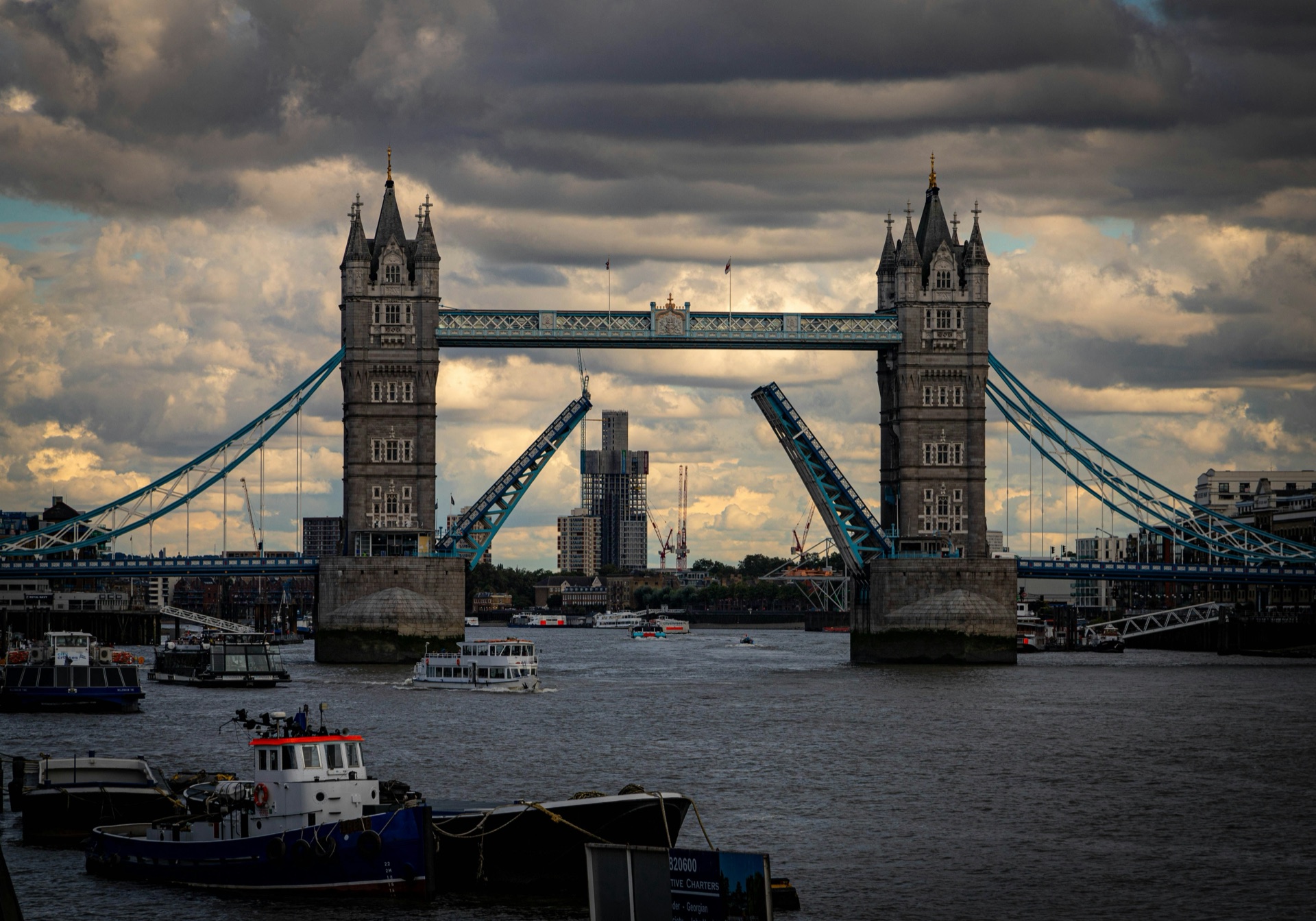
London on $50, $180 or $700 a day
London is one of the world's great cities — a place where a free world-class museum sits next to a Michelin three-star, where the Tube costs £2.80 and a hotel suite costs £2,800. Messy, multicultural, and permanently surprising, it rewards every type of traveller.
Share
Plan by budget
One city, three ways to travel it.
How much does London cost per day? Budget travellers get by on about $50 a day, mid-range trips run around $180, and luxury starts near $700 — accommodation, food, transport and activities included. That makes London the 15th most expensive of 110 cities for a mid-range trip (see all 110 ranked).
Daily budget · Budget
London on a budget is tough but not impossible. The secret weapons: free world-class museums, the Oyster card for cheap transport, and an extraordinary street food and market scene that costs almost nothing.
Where your money goes
How to Get There
What to Do
A thousand years of fortress, prison and palace — the Crown Jewels, the ravens, and Yeoman Warders telling the best-rehearsed stories in Britain.
Read guide → Map ↗ Get tickets on Tiqets →The 135-metre wheel that was meant to be temporary — 30 minutes over the Thames with Parliament at your feet, best taken with the river cruise combo.
Read guide → Map ↗ Get tickets on Tiqets →The actual sets, props and creatures of all eight films — Great Hall to Diagon Alley to a butterbeer, in the studios where they were made.
Read guide → Map ↗ Get tickets on Tiqets →Where to Stay
Compact but smart rooms in Shoreditch, great transport links
Map ↗ Check prices on Klook →Dependable budget chain hotel: compact rooms, consistent standards, usually near transit.
Map ↗ Check prices on Klook →Huge modern hostel in Bloomsbury, near British Museum, good bar
Map ↗ Check prices on Klook →Where to Eat
Bombay café institution — the bacon naan at breakfast is legendary, always a queue
Map ↗Best steak for the price in London, no reservations — just queue
Sample 3-Day Itinerary
Free Museums & the Thames
British Museum (free - the Rosetta Stone, the Elgin Marbles, the Lewis Chessmen. Allow 3 hours minimum). Walk south to the Thames via Covent Garden (free street performers).
South Bank walk from Waterloo Bridge to Tower Bridge (free). Tate Modern (free permanent collection - the Turbine Hall installation alone justifies the visit). Borough Market for a £5-8 lunch (Monmouth Coffee, raclette stands, bread).
Tower of London from the outside at night (free - the floodlit towers are extraordinary). Dinner at a Shoreditch curry house on Brick Lane (£10-14 for a full meal). Beigel Bake at midnight: a salt beef beigel for £4.
Parks & East London
Hyde Park and Kensington Gardens (free - 630 acres of central London parkland). The Serpentine Gallery (free). Walk to Notting Hill: Portobello Road for browsing (don't buy antiques without knowing prices).
Brick Lane: the Sunday Market (if Sunday) or the Spitalfields Market. Old Truman Brewery galleries (free). Walk south to the City: St Paul's exterior, the Millennium Bridge, the Sky Garden (free with booking at skygarden.london).
Camden for the evening: the Roundhouse for a gig (£15-25) or just the market pubs. The Hawley Arms or the Lock Tavern for a pint (£6). Dinner at a Camden Market stall (£8-12).
Greenwich & South East
DLR to Greenwich (£2.80). National Maritime Museum (free). Royal Observatory - stand on the Prime Meridian in the courtyard (free). Greenwich Park hill for the London skyline view.
Greenwich Market for lunch (£6-10). Thames Clipper back to Westminster (£7). National Gallery (free - Van Gogh's Sunflowers, the Arnolfini Portrait, Turner's Fighting Temeraire). Walk Trafalgar Square.
Sunset from Waterloo Bridge (the best free view in central London: St Paul's to the east, the Houses of Parliament to the west). Dinner at a Waterloo pub: pie and a pint for £14. Last Tube home.
Get an Oyster card — capped daily at £8.10 for zones 1-2. The British Museum, Tate Modern, National Gallery and V&A are all completely free. Eat at Borough Market on weekdays (Saturday is a zoo).
Daily budget · Mid-range
Mid-range London is great value by global standards. You get proper boutique hotels in Shoreditch or Soho, restaurants that are genuinely world-class (not just expensive), and experiences that most visitors miss entirely.
Where your money goes
How to Get There
What to Do
A thousand years of fortress, prison and palace — the Crown Jewels, the ravens, and Yeoman Warders telling the best-rehearsed stories in Britain.
Read guide → Map ↗ Get tickets on Tiqets →The 135-metre wheel that was meant to be temporary — 30 minutes over the Thames with Parliament at your feet, best taken with the river cruise combo.
Read guide → Map ↗ Get tickets on Tiqets →The actual sets, props and creatures of all eight films — Great Hall to Diagon Alley to a butterbeer, in the studios where they were made.
Read guide → Map ↗ Get tickets on Tiqets →Where to Stay
SE1 boutique, Sunday antiques market outside, excellent restaurant
Map ↗ Check prices on Klook →Iconic East London boutique, excellent lobby bar, great neighbourhood
Map ↗ Check prices on Klook →Mod-designed rooms with Tower of London views, great value for location
Map ↗ Check prices on Klook →Where to Eat
London's best tapas bar, no reservations — queue or bar seats only
Sample 3-Day Itinerary
History & the River
Tower of London (£33.60 - the Crown Jewels, the ravens, the Beefeaters, 900 years of history). Tower Bridge exhibition (£12.30) - the glass walkways above the river are vertigo-inducing.
Lunch at Borough Market (£15-20 at a proper stall). Tate Modern (free) then walk the South Bank to the National Theatre. The BFI Southbank for a film or exhibition.
Dinner in Shoreditch: Brat (wood-fired, excellent, £45-60) or the Clove Club (modern British tasting menu, £85 - book weeks ahead). Cocktails at the Nightjar or the Experimental Cocktail Club.
Museums & Chelsea
Victoria and Albert Museum (free - the greatest decorative arts museum in the world; the Cast Courts, the Islamic collection, the Fashion Gallery). Then the Natural History Museum next door (free - the diplodocus skeleton).
Lunch in Chelsea or South Kensington (£20-25). Saatchi Gallery (free - often the most interesting contemporary art show in London). Walk the King's Road.
Dinner in Notting Hill: The Ledbury (book months ahead, exceptional modern British, £70-90) or a more casual dinner on Westbourne Grove (£30-40 at any of the good Italian and modern British options).
Day Trip: Bath or Cambridge
Train to Bath (1.5h, £20-30 return) or Cambridge (50min, £25 return). Bath: the Roman Baths (£24), the Royal Crescent, Sally Lunn's bun. Cambridge: the Backs (free), King's College Chapel (£10), punting on the Cam (£20).
Lunch in Bath or Cambridge (£15-20). Return to London by late afternoon.
Final dinner in Covent Garden or the West End: an Ivy Market Grill pre-theatre dinner (£35-45) and a West End show (£30-80 depending on seat - TKTS booth in Leicester Square sells same-day discounted tickets). The best value in London entertainment.
Stay in Shoreditch or Bermondsey for better value than Mayfair. Book restaurants on OpenTable 2 weeks ahead. The Barbican and Southbank have world-class performances for under £30.
Daily budget · Luxury
Luxury London rivals Paris and New York — with the added benefit of understatement. The best hotels here are the world's best, the restaurants are extraordinary, and the private club culture means the real London is hidden from view.
Where your money goes
How to Get There
What to Do
A thousand years of fortress, prison and palace — the Crown Jewels, the ravens, and Yeoman Warders telling the best-rehearsed stories in Britain.
Read guide → Map ↗ Get tickets on Tiqets →The 135-metre wheel that was meant to be temporary — 30 minutes over the Thames with Parliament at your feet, best taken with the river cruise combo.
Read guide → Map ↗ Get tickets on Tiqets →The actual sets, props and creatures of all eight films — Great Hall to Diagon Alley to a butterbeer, in the studios where they were made.
Read guide → Map ↗ Get tickets on Tiqets →Where to Stay
The quintessential London grand hotel, Art Deco masterpiece in Mayfair
Map ↗ Check prices on Klook →Knightsbridge legend, Harvey Nichols next door, Dinner by Heston inside
Map ↗ Check prices on Klook →Former Midland Bank HQ, nine restaurants, rooftop pool, private club feel
Map ↗ Check prices on Klook →Where to Eat
Michelin-starred historical British gastronomy at Mandarin Oriental
Map ↗2 Michelin stars, Brett Graham's finest — one of Europe's great restaurants
Map ↗3 Michelin stars in Chelsea, the oldest of London's three-star restaurants
Map ↗3 Michelin stars, former Gordon Ramsay head chef's masterwork in Notting Hill
Map ↗Sample 3-Day Itinerary
Royal London & Kensington
Private Buckingham Palace tour during the summer opening (August-September only, £30 - the State Rooms are extraordinary). Or: a private art history tour of the National Gallery with a Courtauld Institute scholar.
Lunch at The Ritz (Afternoon Tea, £78 - book 3 months ahead. The Palm Court is one of the most beautiful rooms in Britain). Shopping in Mayfair: Burlington Arcade, New Bond Street, Mount Street.
Dinner at The Clove Club (modern British, 2 Michelin stars) or Core by Clare Smyth (2 Michelin stars - the finest modern British restaurant in London, £150pp for the tasting menu). Nightcap at the American Bar in the Savoy - one of the world's great cocktail institutions.
Art, Auction Houses & Soho
Christie's or Sotheby's private viewing (free to attend during pre-sale exhibitions - the art on display is extraordinary and the rooms are magnificent). Then the Courtauld Gallery (£14 - Manet's A Bar at the Folies-Bergère, Van Gogh's Self-Portrait with Bandaged Ear).
Lunch at Scott's in Mayfair (the best seafood restaurant in London, £60-80). Private Bond Street shopping: Cartier, Graff, Asprey. Or a Savile Row bespoke consultation at Anderson & Sheppard or Huntsman.
Dinner at Sketch (the Lecture Room, 2 Michelin stars - one of the most theatrical dining experiences in London) or at Alain Ducasse at The Dorchester (3 Michelin stars). Cocktails at Annabel's members bar if with a member.
Countryside & Farewell
Chauffeured day to the Cotswolds: Bourton-on-the-Water, Burford, and a private lunch at a Cotswolds country house hotel (Le Manoir aux Quat'Saisons in Great Milton - 2 Michelin stars, Raymond Blanc's flagship). Book the lunch menu (£180pp).
Return to London via Oxford (15-minute stop at the Bodleian Library and Christ Church meadow). Arrive by 5pm.
Farewell dinner at Restaurant Gordon Ramsay in Chelsea (3 Michelin stars, the most consistent fine dining room in London, £175 tasting menu). Or The Ledbury for a more relaxed but equally brilliant £120pp experience. Thames sunset walk after.
Book The Ledbury and Core by Clare Smyth months in advance — they are among the world's genuinely great restaurants. Claridge's Art Deco bar at midnight is a London ritual for a reason.
Sight guides
London Sight Guides
About London
When to go, and what it's like on the ground.
Best time to visit
May – June, September
Oceanic climate: mild, overcast, and unpredictable year-round. Summers (June-August) are warm (22°C) but rarely hot - the city thrives. May-June brings long days and the parks at their best. July-August is peak season: crowded and expensive. September-October offers golden light and thinning crowds. December brings Christmas lights along Oxford Street and the markets. Carry a layer at all times.
- January: 5°C average high, 13 rain days, low crowds
- February: 5°C average high, 11 rain days, low crowds
- March: 8°C average high, 11 rain days, moderate crowds
- April: 10°C average high, 11 rain days, high season
- May: 14°C average high, 11 rain days, high season
- June: 17°C average high, 10 rain days, high season
- July: 19°C average high, 11 rain days, high season
- August: 19°C average high, 11 rain days, high season
- September: 16°C average high, 10 rain days, moderate crowds
- October: 12°C average high, 11 rain days, moderate crowds
- November: 8°C average high, 12 rain days, low crowds
- December: 6°C average high, 13 rain days, moderate crowds
Getting around
Getting around London
The London Underground (the Tube) is the backbone: 11 lines, open until midnight (later on weekends). Tap an Oyster card or contactless bank card directly - no tickets needed. Single journeys cost £2.80 in Zone 1; the daily cap is around £8.10. The Overground, Elizabeth line, DLR, and buses extend the network. Black cabs are metered and available at night; rideshares (Uber) are widespread. Most central London is walkable - the distances between stations on the map are deceptive.
A travel eSIM gets you online the moment you land in United Kingdom — data plans start at $4 — no roaming bill, no queue for a local SIM, and nothing to swap in and out of your phone. Install it before you fly.
On foot
Walking routes in London.
The Rosetta Stone, the garden squares of the Bloomsbury Group, Dickens's house, the Gothic front of St Pancras and the canal at King's Cross.
The tea clipper, the Painted Hall, the market, the meridian line and the view back over London from the hill.
A Victorian market hall, Hawksmoor's church, the silk weavers' houses, Brick Lane's bagels and the street art of Shoreditch.
The river walk east from the Eye past the Globe and Borough Market to Tower Bridge.
The palace guard, the pelicans, the royal grocer, the Regency arcade, the Royal Academy, Savile Row, Bond Street and afternoon tea at Claridge's.
The Tower and the Crown Jewels, a bombed church turned garden, the glasshouse on top of the Walkie-Talkie, Leadenhall Market and the Roman arena under the Guildhall.
The abbey, Whitehall, Trafalgar Square and Covent Garden, then the river crossing to St Paul's and Tate Modern.
The British Museum, lunch in Chinatown, the V&A and the Natural History Museum, the Albert Hall, the Serpentine, sunset on Primrose Hill and dinner in Camden.
The Tower at opening, Tower Bridge, lunch at Borough, Tate Modern and St Paul's, Covent Garden, the National Gallery, Parliament and the London Eye at dusk.
Where to stay
London, neighbourhood by neighbourhood.
South Bank & Westminster
The north and south banks of the Thames from Westminster Bridge to Tower Bridge contain most of what people picture when they picture London: the Houses of Parliament, Big Ben, Westminster Abbey, Tate Modern, the Globe Theatre, Borough Market, and the HMS Belfast. The South Bank walk between Waterloo Bridge and Tower Bridge is the finest free urban promenade in Europe - especially at night when the buildings are lit and the river reflects everything.
Best for mid-rangeShoreditch & East London
London's creative east: Brick Lane (Bangladeshi food, vintage markets, Beigel Bake open 24h), the Columbia Road Flower Market on Sundays, the Old Spitalfields Market, and the Shoreditch street art scene that's been evolving since Banksy. The neighborhood runs from the financial edge of Liverpool Street into a world of gallery spaces, concept restaurants, and weekend morning markets. The Ace Hotel area is the social center.
Best for mid-rangeNotting Hill & Portobello
The neighborhood of the movie and the real: Portobello Road Market (Friday-Saturday is best for antiques, Friday morning for serious dealers), the pastel-colored townhouses of Westbourne Grove, and the garden squares behind them. Holland Park and Kensington Gardens adjoin it. One of London's most photographed streets (Elgin Crescent) is here - and it's exactly as beautiful as it looks.
Best for mid-rangeMayfair & St James's
The most expensive real estate in London and, arguably, in Europe. Mayfair has the Ritz, Claridge's, the Connaught, Annabel's, and Bond Street's entire luxury mile. St James's has the gentlemen's clubs of Pall Mall, Christie's and Sotheby's auction houses, and Berry Bros & Rudd - the oldest wine merchant in Britain (founded 1698, still in the same shop). The Royal Academy is on Burlington Arcade. Walk it on a weekday morning when the city is at its most composed.
Best for luxuryCamden
London's rock-and-roll neighborhood: the Camden Market complex sprawls around the Regent's Canal with hundreds of stalls selling street food, vintage clothes, and everything else. The Lock Market and Stables Market are the most interesting. The Electric Ballroom is one of London's legendary live music venues. Amy Winehouse grew up here. The canal walk from Camden to Islington is one of London's best free walks.
Best for budgetGreenwich
Southeast London by DLR or river boat: the Cutty Sark (the last surviving tea clipper), the National Maritime Museum (free), the Royal Observatory where the Prime Meridian runs through the courtyard (free to stand on, £16 to go inside), and Greenwich Park - the best hill view of the London skyline outside a helicopter. The Sunday antiques market in the Covered Market is excellent. The journey by Thames Clipper from Westminster is itself a reason to go.
Best for budgetLocal etiquette
Dos & Don'ts
Do
- Queue — orderly queuing is sacred
- Stand right on escalators (especially on the Tube)
- Tip 12.5% at restaurants unless service is included
- Apologise for things that aren't your fault — it's social glue
- Tap an Oyster or contactless card on the Tube
- Look right first when crossing — cars come from the "wrong" side
Don't
- Make small talk on the Tube — silence is the rule
- Block the left side of escalators
- Refer to England as Britain — they're not the same
- Stop suddenly on busy pavements — Londoners commute fast
- Tip in pubs — order at the bar and pay then
- Photograph strangers without asking
Useful phrases
Say it like a local.
Beyond the city
Day trips worth the journey.
Oxford
Honey-stone colleges and pub gardens of the medieval university city.
Bath
Roman baths and Georgian crescents — a Cotswold gateway.
Windsor & Eton
Windsor Castle and Eton College on the Thames.
Stonehenge & Salisbury
The Neolithic stone circle plus a medieval cathedral.
Brighton
The seaside city with the Royal Pavilion, pier and lanes shopping.
Where to eat
Must-try dishes.
Sunday Roast
Beef, lamb or pork with Yorkshire pudding, roast potatoes and gravy — the Sunday-lunch ritual.
Fish & Chips
Battered cod or haddock with thick chips, mushy peas and vinegar.
Full English Breakfast
Eggs, bacon, sausages, beans, tomato, mushrooms and toast — fuel for the day.
Bangers & Mash
Sausages with creamy mash and onion gravy — pub comfort food.
Beef Wellington
Tenderloin in mushroom duxelles and puff pastry — a London classic.
Indian Curry
Brick Lane and Tooting curry houses are an institution; tikka masala was invented here.
Afternoon Tea
Finger sandwiches, scones with clotted cream and pastries with a pot of tea.
Travel insurance
Do I need travel insurance for United Kingdom?
Travel insurance is strongly recommended for any trip to London. Safety is rated Generally safe - standard big-city awareness, especially on the Tube late at night — even in safe destinations, unexpected medical emergencies or trip cancellations can be costly. Make sure your policy covers emergency medical treatment, hospitalisation, trip cancellation, and emergency evacuation.
Visa note: UK Electronic Travel Authorisation (ETA) required for most visa-free nationalities from 2025 - apply online for £10. US, EU, and most Western passport holders qualify. Separate from Schengen - a Schengen visa does not cover the UK.. Some countries require proof of travel insurance as part of the visa application.
Good to know
FAQ: London travel questions
Is London safe to visit?
Generally safe - standard big-city awareness, especially on the Tube late at night
When is the best time to visit London?
May – June, September Oceanic climate: mild, overcast, and unpredictable year-round. Summers (June-August) are warm (22°C) but rarely hot - the city thrives. May-June brings long days and the parks at their best. July-August is peak season: crowded and expensive. September-October offers golden light and thinning crowds. December brings Christmas lights along Oxford Street and the markets. Carry a layer at all times.
How much does a trip to London cost per day?
- Budget $50–$105 / day
- Mid-range $180–$300 / day
- Luxury $700–$1500 / day
Do I need a visa to visit United Kingdom?
UK Electronic Travel Authorisation (ETA) required for most visa-free nationalities from 2025 - apply online for £10. US, EU, and most Western passport holders qualify. Separate from Schengen - a Schengen visa does not cover the UK.
How do I get around London?
The London Underground (the Tube) is the backbone: 11 lines, open until midnight (later on weekends). Tap an Oyster card or contactless bank card directly - no tickets needed. Single journeys cost £2.80 in Zone 1; the daily cap is around £8.10. The Overground, Elizabeth line, DLR, and buses extend the network. Black cabs are metered and available at night; rideshares (Uber) are widespread. Most central London is walkable - the distances between stations on the map are deceptive. London has a metro system. Taxi base fare ~$4. Day pass ~$15.
Is tipping expected in London?
10-12.5% at restaurants, often added automatically as a "service charge" - check the bill before adding more. Taxi drivers and hotel staff: round up or £2-5. Not expected at pubs.
What currency is used in United Kingdom?
The local currency is GBP (£) - pound sterling. Cards accepted almost everywhere; contactless is universal., and the official language is English.
Compare
London vs other cities
Onward